

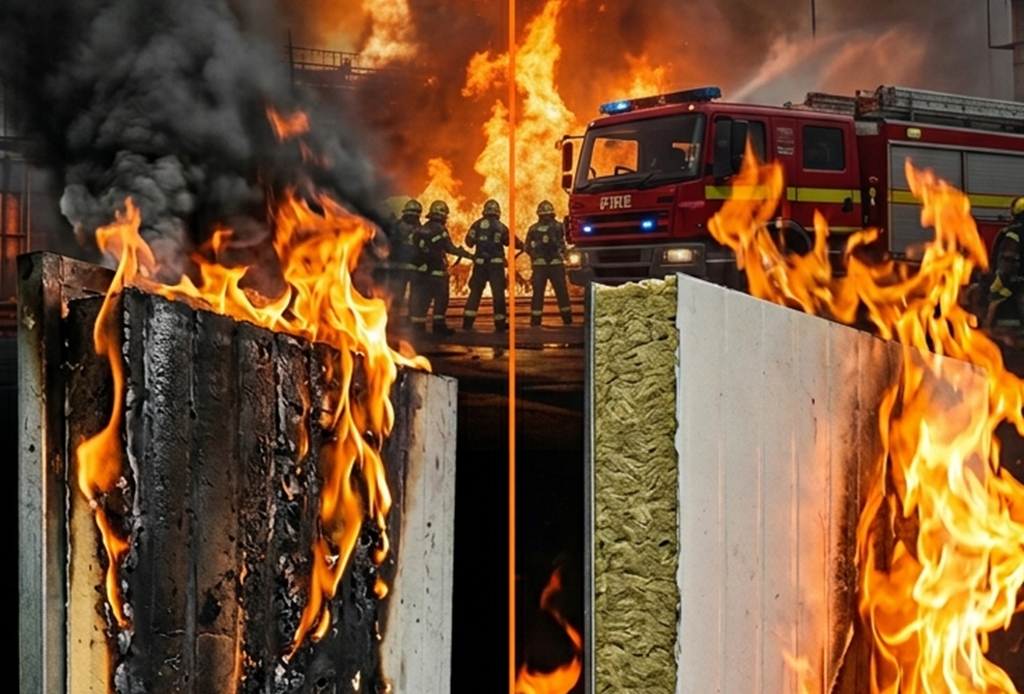
Fire safety is one of the most important considerations when designing and constructing steel buildings. Whether the project is a warehouse, factory, production facility, commercial building, or logistics center, selecting the right sandwich panel system can significantly impact both safety and long-term performance.
to watch video click here
Among the most commonly used insulation core materials in sandwich panels are PIR (Polyisocyanurate) and Rockwool. While both offer valuable benefits, they differ considerably in terms of fire performance, thermal insulation, and intended applications.
What Are PIR Sandwich Panels?
PIR sandwich panels feature a rigid polyisocyanurate foam core designed to provide excellent thermal insulation while offering enhanced fire resistance compared to traditional polyurethane insulation.
One of the key advantages of PIR panels is their ability to limit flame spread. When exposed to fire, PIR insulation can form a protective char layer that helps slow down combustion and reduce fire propagation. This makes PIR panels a popular choice for warehouses, industrial buildings, commercial facilities, and cold storage projects where energy efficiency and fire resistance are both important.
Key Benefits of PIR Panels
- Excellent thermal insulation performance
- Lightweight construction
- Reduced energy consumption
- Improved fire resistance compared to conventional PU insulation
- Cost-effective solution for many industrial applications
What Are Rockwool Sandwich Panels?
Rockwool sandwich panels contain a core made from mineral wool produced from natural volcanic rock. Unlike organic insulation materials, Rockwool is non-combustible and does not contribute to fire spread.
Because of its exceptional fire performance, Rockwool is widely used in facilities where fire protection requirements are particularly demanding. These include manufacturing plants, chemical facilities, industrial complexes, and buildings that must comply with strict fire safety regulations.
Key Benefits of Rockwool Panels
- Non-combustible insulation core
- Outstanding fire resistance
- Reduced heat transfer during fire exposure
- Excellent acoustic insulation properties
- Suitable for projects requiring high fire ratings
When Should You Choose PIR?
PIR sandwich panels are often the preferred solution when the project requires:
- High thermal insulation performance
- Energy efficiency
- Lightweight building systems
- Good fire resistance combined with competitive costs
For many warehouses, workshops, logistics facilities, and commercial buildings, PIR panels offer an excellent balance between performance and budget.
When Should You Choose Rockwool?
Rockwool panels are typically selected when fire safety is the primary concern. They are ideal for:
- High-risk industrial facilities
- Manufacturing plants
- Buildings with strict fire protection requirements
- Projects requiring enhanced compartmentalization against fire spread
In environments where achieving the highest level of fire protection is essential, Rockwool remains one of the safest insulation solutions available.
The Importance of Selecting the Right Sandwich Panel
There is no universal solution suitable for every project. The choice between PIR and Rockwool should be based on several factors, including building usage, fire safety requirements, thermal performance targets, local regulations, and project budget.
At Hassanoglu Steel Structures, we help our clients select the most appropriate sandwich panel system for their specific project requirements. Through professional engineering, high-quality manufacturing, and customized steel building solutions, we ensure that every project achieves the optimal balance between safety, efficiency, and long-term performance.
Looking for the Right Steel Building Solution?
Contact Hassanoglu Steel Structures to discuss your project requirements and receive expert guidance on steel structures, sandwich panel systems, and fire-resistant building solutions.