

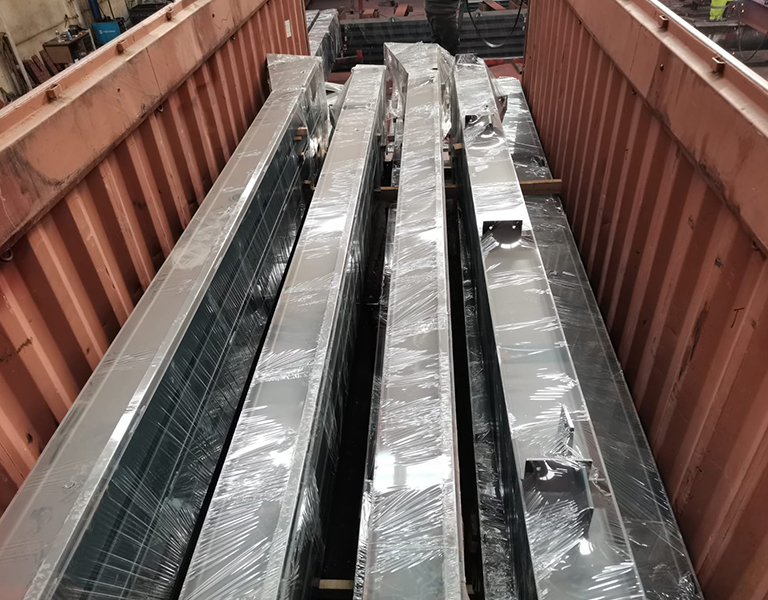
With the expansion of construction and industrial projects around the world, steel structures are often manufactured in one country and transported to another for installation. This raises an important question: how are these massive steel structures shipped across the world?
to watch video click here
In practice, steel structures are not transported as a fully assembled building. Instead, they are designed and divided into transportable components that can be shipped efficiently. The shipping method depends on the size, weight, and specifications of the structural elements.
Below are the three most common methods used globally to ship steel structures.
1. Shipping in Standard 40-Foot Closed Containers
This is the most commonly used method for medium-sized projects that are specifically designed for export.
Structural elements such as columns and beams are divided into sections that fit within the dimensions of a standard 40-foot container. The components are then carefully arranged and secured inside the container to maximize space efficiency and ensure safe transportation.
Advantages of this method:
-
Full protection from weather conditions during sea transport
-
Lower shipping costs
-
Easier handling at ports
-
Suitable for most warehouse and factory projects
For this reason, engineers often consider container dimensions during the design stage to optimize the shipping process.
2. Shipping Using Open Top Containers
In some cases, structural elements may be too tall or difficult to load through the standard container doors. This is where Open Top containers become a practical solution.
These containers allow loading from the top using cranes, making them ideal for oversized components.
Open Top containers are commonly used for:
-
Large steel frames
-
Long columns
-
Tall beams or heavy structural elements
-
Components that cannot be loaded horizontally
This method provides greater flexibility while still maintaining the advantages of containerized shipping.
3. Shipping via RORO (Roll-on / Roll-off) Vessels
For very large projects, some steel components may be too heavy or oversized to fit inside containers. In such situations, RORO vessels are often used.
With this method, the steel elements are loaded onto trucks or trailers. These vehicles then drive directly onto the ship, where they are secured on the vessel’s deck.
Advantages of RORO shipping:
-
Suitable for extremely large steel structures
-
Allows transportation of very long components
-
Reduces the need to divide structures into many smaller parts
-
Ideal for major industrial and infrastructure projects
Smart Design Starts with Shipping in Mind
In international steel structure projects, engineering does not end with structural design. It also includes logistics planning for transportation and shipping.
A well-planned design that considers shipping requirements can help:
-
Reduce transportation costs
-
Simplify logistics operations
-
Speed up installation at the project site
-
Minimize risks during handling and transport